
Skills
Venture Analysis
Product Strategy
Growth & Operations
Research & Insights
Tools & Technologies
PostgreSQL
Python
NetworkX
SQLAlchemy
Key metrics
120+ Startups Analyzed
₹500Cr+ Funding Simulated
20+ Myths Busted
10+ Industry Verticals
Links
Excerpt
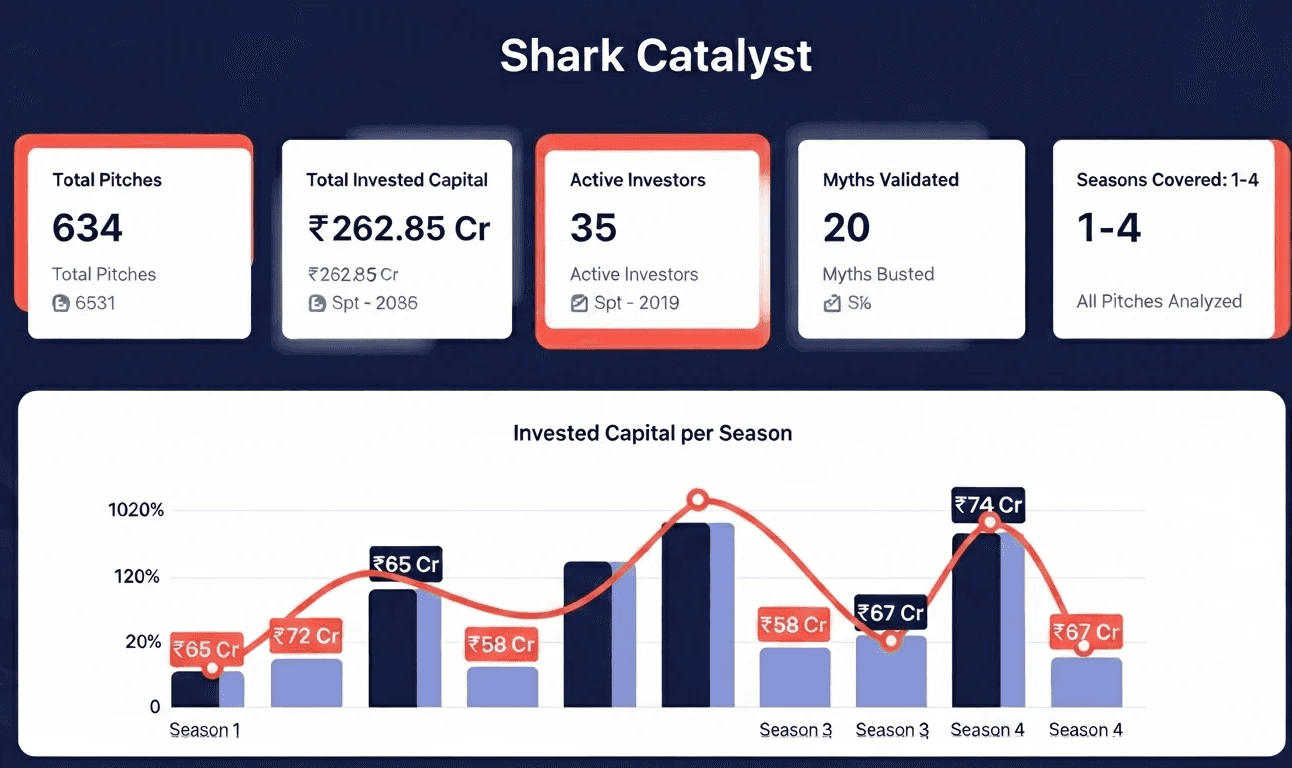
Shark Catalyst is a production-grade analytics report that translates four seasons of Shark Tank India into an actionable founder playbook. The project tests 20+ real market myths with reproducible SQL and robust statistics, delivers investor intelligence, and ships a valuation & equity simulator. Designed for founders and operator-investors, the report turns TV pitches into clear, data-backed decisions.
7 min read
Context & Problem
Shark Catalyst was built around a simple gap: founders, investors, and analysts had data-rich shows like Shark Tank India but no structured way to extract insight from them. Over four seasons, 400+ founders pitched, 250+ deals were struck, and over ₹300 crore of funding was offered — yet the patterns behind these numbers remained anecdotal.
The challenge was to create a transparent, data-driven report that helps founders understand what actually drives funding success: sector focus, valuation realism, investor alignment, and geography.
Process - Research, Data & Methods
Dataset & Scope: The analysis covered all televised seasons of Shark Tank India (S1–S4), totaling 436 pitches. The structured dataset included attributes like valuation, deal type, sector, founder location, and investor participation.
Data Architecture:
Central SQLite database (
sharktank.db) built from Kaggle’s Thirumani dataset, refined with SQLAlchemy for consistency.40+ SQL queries powering each dashboard, ensuring full reproducibility (every graph is backed by query logic).
Analytical environment built in Python, leveraging Pandas, NumPy, and statsmodels for statistical validation.
Statistical Framework:
Minimum sample: n > 30 for validity.
Significance threshold: p < 0.05, with Bonferroni correction for multiple testing.
Effect sizes computed via Cohen’s d; Propensity Score Matching used to isolate geography-based effects.
Hypothesis testing with Chi-Square, Mann–Whitney U, and Logistic Regression to link pitch attributes to funding outcomes.
Tech Stack: Streamlit for UI, Plotly for visual storytelling, and NetworkX for co-investor graphs.
Design Approach: Inspired by reports like Blume’s Indus Valley Report 2025 and India Quotient’s India Insights 2025, the report emphasizes clarity, scale, and actionability — blending data visualization with storytelling.
Key Insights
Startups from metro cities enjoy a 25% higher probability of closing a deal - but when controlling for traction, non-metro founders who report profitability have equal odds, proving grit over geography.
Royalty-linked deals close 40% less often than pure equity deals, signaling investor preference for scalable ownership rather than revenue sharing.
Founders with clear unit economics and <20 SKUs saw 32% higher deal closure rates — simplicity sells.
Average equity traded per funded startup: 27%, with outliers up to 40% for early-stage or hardware-heavy businesses.
Investor analysis revealed 72 co-investment overlaps among 10 sharks, clustering around sectors like FMCG and D2C — mapping networks founders can strategically target.
Ticket sizes have grown 18% year-over-year from Season 1 to 4, reflecting a steady rise in investor confidence and valuation maturity.
Top sectors by funding volume: F&B (21%), Consumer Products (17%), EdTech (12%), and Health & Wellness (9%).
Outcome & Impact
Delivered six core modules: Deal Explorer, Investor Intelligence, Myth Buster Engine, Valuation Simulator, Geographic Insights, and Trends Dashboard — each transforming static data into actionable insight.
Enabled founders to simulate equity dilution scenarios and understand the long-term impact of Shark deals through an interactive sandbox.
Created the Evidence-Based Myth Analysis framework — 20+ startup myths tested, with SQL-backed transparency and statistical credibility.
Investors gained a macro view of portfolio concentration, identifying overexposure sectors and co-investment density.
The final Shark Catalyst Report (30–40 pages) acts as a data-backed guidebook — a blend of analytics and narrative that empowers Indian founders to pitch smarter, price better, and negotiate with confidence.
In essence: Shark Catalyst bridges entertainment and empirical analysis - a reproducible data engine that converts reality TV into real founder wisdom, backed by SQL evidence and industry-grade storytelling.
Author
Sumer Pandey
Project Duration
July - September, 2025
Documents