Project Overview
The Smart Drone project addresses challenges in apple orchard management in Himachal Pradesh, including low efficiency in plant health monitoring, costly drone solutions, and unoptimized fertilizer/pesticide application.
Problem Statement
Commercial multispectral drones cost ₹3L+, making them inaccessible to most farmers.
Current monitoring methods are manual, time-consuming, and prone to error.
Fertilization and pesticide application is generalized, causing waste and environmental impact.
Process & Execution
Conceptual Design: CAD modeling of drone structure, electronics architecture, and weight/power optimization.
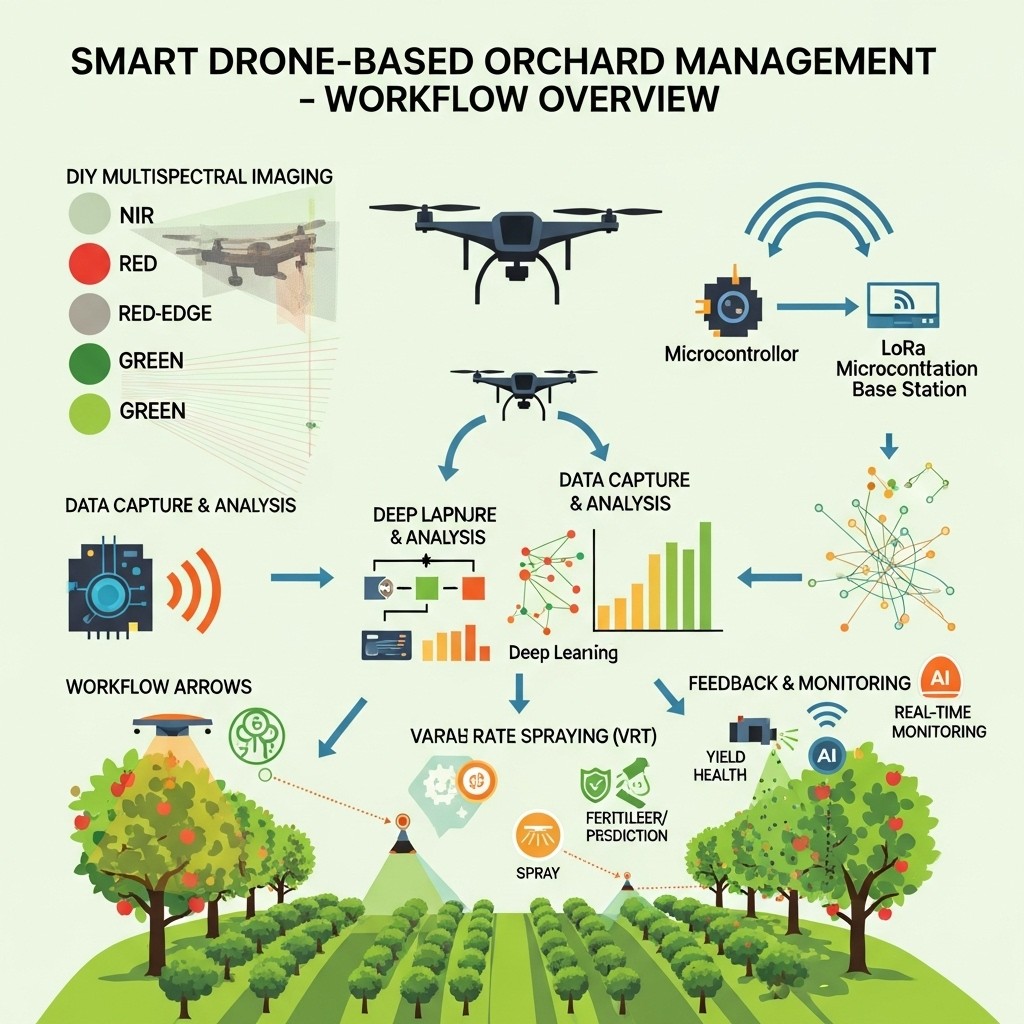
Multispectral Imaging: DIY sensors covering NIR (700–1000 nm), Red (620–750 nm), Red-Edge (700–750 nm), and Green (500–600 nm).
Electronics & Communication: Microcontroller-based central unit with LoRa long-range modules for orchard-wide coverage.
Deep Learning Models: Early disease detection and yield prediction trained on spectral band data.
Variable Rate Spraying (VRT): Fertilizer and pesticide application linked to plant health maps, reducing resource usage.
Outcome & Impact
Reduced cost by ~70–80% compared to commercial solutions.
PDEU university-level winners; advanced to national top 50.
Potential for early disease detection, yield prediction, and precision spraying at scale.
Demonstrates feasibility of low-cost, scalable, farmer-friendly drone solutions.
Team & Roles
Sumer Pandey: Microprocessors & Electronics, Project Lead
Dhruv Rathod: Communication Systems, LoRa architecture
Kandarp Trivedi: Electronic subsystem integration
Kashish Sharma: Mechanical CAD design and structural modeling
Diya: Software interface and control flow
Jimit Chavda: Deep learning for yield prediction and disease detection
Metrics & Technical Highlights
Plant health bands: NIR, Red, Red-Edge, Green
Communication: LoRa modules with orchard-wide coverage
DIY sensors reduce cost 70–80%
Competition outcome: PDEU winners